Est. 1993

The Foundation’s Story

A chance meeting,
and everything that followed.

A long narrative, by David Steinbuhler, on how the Donison-Steinbuhler Standard came to be, and the three decades of work that turned a good idea into a growing body of evidence and practice.

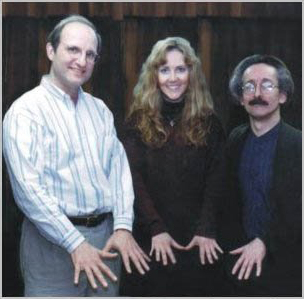
David Steinbuhler, Linda Gould, and Christopher Donison at the piano where Linda's keyboard was measured
David, Linda, and Christopher on the occasion of measuring Linda’s piano

Chapter I

A Big Idea

A chance meeting in the summer of 1991 changed my life. I was visiting the Shaw Festival in Niagara-On-The-Lake and providentially stayed at the bed and breakfast run by Christopher Donison, the Festival’s music director. Christopher had a 7/8 keyboard installed in his concert grand piano. An octave on his keyboard was equal to a 7th on the conventional keyboard. While studying music at the University of Victoria he had realized that his small hand size was preventing him from mastering much of the great piano repertoire, and had the keyboard built in the late 1970s.

I play the piano a little, and the ease with which I adapted to his smaller keyboard amazed me. Christopher explained how a whole new unknown world had opened before him when he first got the keyboard, and that this had inspired the concept of creating a second standard. “This,” I said, “is a big idea.”

I had been developing products in our family-owned textile business in Titusville, PA, and believed this was an opportunity placed before me. I had computer programming experience, and the idea of building keyboards out of a computer database intrigued me. Never mind that I knew nothing about the piano industry. I told Christopher I would try to build small keyboards, and he conceived the idea of calling the new proposed keyboard size the Donison-Steinbuhler Standard. The DS Standard® was born. To designate it on the keyboard itself, Christopher designed the DS logo we would attach to the front of the first bass key.

Chapter II

“It IS Easy!”

In the freedom of having no preconceived ideas about how to build keyboards, I started tinkering more or less as a hobby. One thing led to another, and by the summer of 1994, on the loading dock of our textile plant, using a computer-driven router, a coworker and I built our first keyboard, which we installed in my mother’s Steinway upright. Linda Gould, an acquaintance of Christopher’s, flew from Victoria, BC to try it. She had given up her dream of becoming a concert artist because of the pain she experienced when playing. I will never forget her exclaiming “It IS Easy!” after spending an emotional afternoon with the piano. It was my first experience watching a serious pianist discover the smaller keyboard.

On the spot Linda decided to buy a keyboard for her Yamaha grand. I turned my attention to grand keyboards and the nagging key-strength issue. By January 1996, after building prototype keyboards for my Steinway B, I was ready, and we flew to Victoria to measure Linda’s piano. Two months later, relying heavily on Linda’s technician to mount the action stack and do the fitting, we sold our first DS Standard keyboard.

Chapter III

The Catch 22

We knew that before acceptance of the keyboard could become a reality, universities would have to work with and endorse them, so we got a grant and “seeded” five universities with keyboards. There followed a flurry of news media attention. National Canadian TV interviewed Christopher with his keyboard; newspapers, loving the story, ran feature articles. The lay person intuitively understands that pianists with different hand sizes need pianos with different keyboard sizes and wonders why it had never been done before.

Piano teachers and serious students, on the other hand, were afraid to touch them. We got no immediate response from the media attention, and no one at the seeded universities worked with the keyboards. Since the keyboards did not exist elsewhere, everyone believed their careers would be hurt by working with them. Acceptance was probably going to take a generation.

Chapter IV

What Size Keyboards?

The lack of response to the media attention was a blessing, because much work needed to be done. I was convinced of the keyboard’s importance; but to make recommendations as to size, there needed to be a study evaluating the complete range of possible standards. We began building keyboards of every size and one by one pianists started coming to Titusville to play them. They were young and old, male and female, pianists who struggled with pain and pianists who simply wanted to play a larger repertoire. It was fascinating to observe them experiment, and this research gave me a solid basis for determining what standards to recommend. In addition to a 7/8 keyboard we also added a size in the middle that we called the “Universal,” designated 15/16.

We used the nomenclature 7/8 and 15/16 to designate the two sizes, but over the years the use of these fractions proved to be confusing. In 2014 we changed the nomenclature to one that reflects the size of the keyboard’s octave: instead of DS-7/8 we now use DS5.5®, and instead of DS-15/16 we now use DS6.0®.

Chapter V

Suitable for Professional Use?

To be taken seriously, our keyboards needed to be of the highest quality. Early on, a keyboard we made for a Steinway C was rejected by a prestigious piano rebuilder in New York City who told us it was “not suitable for professional use.” In those days we needed to work with rebuilders, as our rough frame needed to be fitted to the piano and the action stack mounted. Their complaint was the springy nature of the highly angled keys in the bass.

That rejection led us to develop techniques for measuring key strength and, ultimately, the “brace,” which completely eliminated the problem. Attention to the engineering aspects of the keys has always been of deep interest to me; I needed to know whether a truly professional reduced-size keyboard could be built at all.

Chapter VI

First University Study

Through the inspiration of Dr. Carol Leone, Southern Methodist University became the first university to purchase and study an alternative size piano keyboard. In the fall of 2000 we fitted the Steinway B in her studio with a 7/8 (DS5.5®) keyboard. She and several of her students started working with and performing on it, enjoying remarkable results. By the end of the school year, Carol had personally committed herself to using the DS5.5®, believing that it would revolutionize traditional teaching of children and small-handed pianists and offer relief to pianists with injuries.

For a full account of her findings, please read her article Goldilocks Had a Choice published in American Music Teacher.

Chapter VII

Interchangeable Keyboards

Carol Leone’s desire to demonstrate these findings at other universities inspired us to build a keyboard with adjustable features that would allow it to be installed in the Steinway concert grand pianos of different universities. We wanted to see how practical and transportable such a keyboard might be. By the spring of 2002 the keyboard was ready, and Carol scheduled recital demonstrations at five universities. I took the keyboard to each in advance to see how well it would fit. We found that it could be adjusted and regulated to play quite well, and that spring the University of Oklahoma, Baylor, Rice, Texas Tech, and the University of Nebraska–Lincoln were witness to recitals given on a Steinway concert grand with a DS5.5® keyboard.

Although it has not proven practical for an artist to take her DS Keyboard with her to be installed in the pianos of different venues, the experience we gained developing the adjustable features was valuable. It gave us the ability to build a replacement keyboard that can easily be installed in a grand piano without changing anything on the piano. Once a new keyboard has been installed, it can be exchanged back and forth with the conventional keyboard in just a matter of minutes. This has opened the way for universities to provide keyboards that best fit their students’ hands and to study all the practical ramifications.

Chapter VIII

Growing University Interest and Research

Southern Methodist University purchased a DS5.5® keyboard for their concert hall and two uprights with DS5.5® keyboards for practice rooms. Under the direction of Dr. Lora Deahl, Texas Tech University worked with three DS5.5® keyboards: one in Lora Deahl’s studio Steinway B, one for their concert hall, and one in an upright in a practice room. Lora measured the preferences of pianists of different ages, genders, and hand sizes for the conventional versus the 7/8 keyboards. Students at both SMU and Texas Tech performed recitals on them, and the two universities collaborated with each other in joint recitals.

Dr. Pamela Mia Paul and Dr. Kris Chesky worked with DS6.0® keyboards at the University of North Texas. Kris, director of the Texas Center for Music and Medicine, initiated formal research to address the increasing evidence that a high percentage of pianists struggle with arm, wrist, and hand pain and have associated medical problems. They endeavored to understand why these problems occur and whether the risk is reduced with the use of alternative keyboards.

Using DS5.5® keyboards at the University of Nebraska–Lincoln, Dr. Brenda Wristen also initiated a formal study of the factors that cause injuries among pianists. She collaborated with Dr. Susan Hallbeck in the department of engineering to electronically measure the stress in the muscles of pianists as they play different size keyboards. Their results showed a big difference in levels of fatigue.

Chapter IX

Working with Children

Dr. Carol Leone again led the way as the first teacher to conduct studies with children. In January of 2005 she began teaching young Aaron Kurz, who had an upright piano with a 7/8 keyboard on which to practice in his home. Carol wrote, “I have performed a preliminary study with one student, ten-year-old Aaron Kurz, who after one year of study on the 7/8 piano keyboard performed a Rachmaninov prelude at the national MTNA 2006 conference. His powerful performance of a piece previously reserved for large-handed pianists broke new ground and astounded those in attendance. One well-known American piano professor was brought to tears by sheer wonderment at a child possessing the ability to present this advanced repertoire by virtue of having a keyboard that suited a child-sized hand.”

Aaron has since grown, made the transition to the conventional keyboard, and gone on to be a winner in two international piano competitions.

Chapter X

National Conference on Keyboard Pedagogy, 2007

Tradition and Transformation: Learning, Playing, and Teaching Outside the Box

The first day of the conference featured the use of the 7/8 DS5.5®keyboard in a concert by Dr. Carol Leone playing a Steinway concert grand fitted with the smaller keyboard. After the concert, the piano was on display in a separate room so that all in attendance could personally experience the keyboard. Two informative videos about the 7/8 keyboard were produced by Mario Ajero: Carol playing the conventional keyboard and then immediately playing the same piece on the 7/8, demonstrating that switching between them is a learnable skill similar to playing the viola and then the violin; and Carol demonstrating the shape of her hand playing chords on a conventional keyboard and then on the 7/8. A third video showed the ease of removing the conventional keyboard from the Steinway concert grand and replacing it with the 7/8.

Dr. Anita Renfroe from Millersville University was recorded playing the 7/8 keyboard for the first time, with her comments. Sarah Evans and Dr. Peter Davis from Bob Jones University shared the results of a study that tested the ability of pianists to adapt to playing on a smaller keyboard. Pianists who practiced one hour a day for five days found significant improvement in accuracy in a short amount of time, and an attitudinal survey revealed that pianists adapted more quickly than they had expected.

Chapter XI

Development of our Technician’s Kit

Rhonda Boyle, who lives in Melbourne on the other side of the world, was determined to get a 7/8 keyboard, and I needed a foolproof method for getting the measurements of her piano. So I put together a set of tools with a booklet of instructions packaged in a handy carrying case, and my wife and I flew to Australia to have a very interesting vacation in late 2008. Rhonda was bubbling with energy to promote alternative keyboards, and I was trying to figure out how to provide them while testing our new Technician’s Kit. Back home, with the data from the kit entered into our computer, we cut out Rhonda’s set of DS5.5® keys, built the action, sent it off, and waited to see if it would fit.

The installation of Rhonda’s 7/8 action was pretty much flawless. Four hours of regulation was all that it required to bring it to perfection, a lot less than some new pianos require. Rhonda is delighted. Look forward to the next installation.

Warwick Dalton, piano technician, Melbourne

Rhonda has become a driving force with her PASK (Pianists for Alternatively Sized Keyboards) website. We continue to refine the Technician’s Kits and send them to technicians around the world to get the measurements we need to build a DS Keyboard.

Chapter XII

Another Powerful Demonstration

At the National Conference on Keyboard Pedagogy 2009, Dr. Kathleen Riley demonstrated her work with ProformaVision, a new product that monitors a pianist’s performance with video and muscle tension, giving real-time visual feedback. Its use helps teachers prove what works in an indisputable manner.

Juilliard Piano Department Chair Veda Kaplinsky stated that both Riley’s research and ProformaVision are a tremendous help to the teaching profession: “Finally we are able to see what is happening as our students play. It is irrefutable proof of what is correct in terms of piano technique.” Former MTNA President Gail Berenson noted that “ProformaVision enables students and their teachers to finally see what is taking place physiologically as they play. They are able to make changes in their physical approach to the instrument to achieve greater efficiency and effortlessness in their playing.”

Chapter XIII

First Piano Manufacturer Installing Our Keyboards

The Walter Piano Company was the first manufacturer allowing us to sell their pianos worldwide built with our keyboards. Our customers select the model, style, and finish of the Walter upright they want, we supply the DS Keyboard size they want, and the Walter Piano Company builds the piano. Walter is a family-owned company located in the USA that has built an impeccable reputation for the quality of their products. Their uprights are known for the richness of their tone and fullness of their bass, and their long keys are especially suited to accommodate the higher angles of our DS Keyboards. We have shipped Walter Studio Upright pianos all around the world, to Australia, Japan, Asia, and Europe.

Chapter XIV

How Far We Have Come

There are two great secrets in the world of piano playing. The first is how much easier the instrument is to play with larger hands, and the second is how impossible it can be with smaller hands.

Christopher Donison

Today, for the first time in the history of the piano, there is a growing list of universities that own and are studying alternative size keyboards. And there is a growing list of pianists who are absolutely thrilled to be playing a keyboard that has literally changed their lives. All the time we get feedback such as: “musically speaking, the DS5.5® has been the greatest spiritual experience of my life. All I want to do is play on it for the rest of my life,” or simply, “It’s fabulous.”

Taken as a whole, great evidence is accumulating that pianists in general are locked in a one-size-fits-all world of profound discrimination. Students who study piano are mostly female, and yet universities provide only pianos with large size keyboards. When we step back to reflect on this, is it not astounding to realize that universities around the world do not provide their students with instruments appropriate to the size of their hands? Today, slowly, they are becoming aware of the two great secrets Christopher Donison discovered when he first got his 7/8 keyboard.

Chapter XV

Where We Are Going

We now know that the smaller keyboards work and that grand pianos are easy to retrofit. But the world of the piano is tied to tradition and will not change easily. How will we ever overcome this impasse? One of the main drivers is probably the growing awareness that alternative keyboards greatly reduce piano-related pain. It is not too strong a statement to say that it is really a question of human rights.

Interestingly, many of the inquiries we receive are requests for smaller electronic keyboards. As awareness and acceptance grow, one day an electronic keyboard manufacturer will provide them; the ability to take your 7/8 keyboard with you when you travel would be liberating.

The Chinese could be a huge factor. A high percentage of the students who study piano are of Chinese ethnicity, and their hand spans measure at the small end of the spectrum. It would seem natural for their piano industry to lead the way. In 2019 we started to work with Hailun USA, a Chinese-based piano company that is enthusiastically promoting DS Standard keyboards. For an industry that has generally been in decline for decades, promotion of the keyboards could be a most welcome boon.

My grandson Alex Steinbuhler and April Larson are committed to keeping our manufacturing operation going.

Chapter XVI

Why We Persist in Our Efforts

Dr. Carol Leone spoke for all of us who are working on this project with a story:

Yesterday I gave an audition lesson to an incoming graduate student. She played a challenging Romantic work with a lot of struggle, even though she intentionally left out many notes to accommodate her small hands. I then found out that she is an injured pianist, with chronic carpal tunnel and nerve damage in her right arm. Then she told me that she came to SMU specifically to study on the 7/8 keyboard. So, over to the 7/8 Steinway we went, and she proceeded to play passages from her piece perfectly with all of the notes. She looked at me incredulously and burst into tears, apologizing over how emotional she felt and exclaiming how she has been trying for years to “discipline myself to stay away from Romantic repertoire.”

More than three decades have passed since I first met Christopher Donison with his vision of a second keyboard standard. Giving thanks for the many blessings and opportunities we have enjoyed, I patiently ask, “What next?” I remain available.

It is clear that piano manufacturers must be involved. To expedite that, the DS Standard Foundation has relinquished the intellectual property rights it has developed through its patents at the margins of keyboard manufacture, specifically the patent for the “brace” (which ensures adequate key strength in the DS5.5® and smaller sizes) and for the use of key-leveling plates.

Pressure is growing beneath the surface, and, although it may take decades, at some point the use of alternative keyboards will become commonplace. In the meantime, building them has become routine for us, and we remain committed to this exciting adventure, believing that we are witnessing the beginnings of an ergonomic revolution.

Continue

Read The Standard in Detail

The specifications, the research behind them, and the ratio that holds every size in the registry together.